
Why Solar Panel Prices Are Falling & How Homeowners Can Save Big
The global solar market is shifting, driving down panel costs and making battery storage essential. Learn how these changes maximize your home's energy savings and ROI right now.
Energy Solutions Team
Home Energy Specialists
The Solar Power Evolution: Why Stabilization Means Massive Savings for Homeowners
If you've been watching the solar energy market, you might have heard whispers about global growth stabilizing. While industry insiders are discussing market adjustments and shifts in competition, for you, the homeowner, this news is overwhelmingly positive.
We are entering an exciting new era—let's call it Solar 2.0. This phase is defined by lower upfront costs for solar panel prices, a critical focus on high-quality execution, and the absolute necessity of home energy storage (battery backup).
At ProsperShield, serving homeowners across 42 US states with over 24,000 installations, we see these shifts as a massive win for residential customers. The market is maturing, which means better technology, better integration, and bigger savings are coming directly to your roof.
This isn't about slowdown; it's about optimization. It’s about ensuring that when you invest in solar, you are getting a system that doesn't just produce power but provides true energy independence and financial security for decades.
Section 1: The Great Price Adjustment—Why Your Solar Investment Just Got Cheaper
One of the most immediate benefits of the global market adjustment is the downward pressure on the core component: the solar module (the panel itself).
Understanding the Global Supply Chain Shift
For the last few years, manufacturing capacity, primarily in Asia, has exploded. While global demand has been robust, the sheer volume of production now slightly exceeds the immediate global deployment rate.
This structural oversupply has a direct and beneficial impact on US homeowners: lower wholesale solar panel prices.
Think of it like a technology maturing. Just as the cost of flat-screen TVs or smartphones plummeted once manufacturing scaled, we are seeing a similar dynamic play out in solar photovoltaics (PV).
What this means for your wallet: The cost of the actual physical panels needed for your roof is decreasing, making the entry point for going solar more accessible than ever before. This significantly improves the ROI (Return on Investment) calculation for residential systems.
Separating Module Cost from System Cost
It’s crucial to remember that the price of the panel is only one part of the total cost of a residential solar system. The final price tag includes what the industry calls “soft costs,” which are arguably more important than the hardware price today:
- Permitting and Inspections: Navigating local bureaucracy and ensuring compliance.
- Labor and Installation: High-quality roofing, electrical work, and system mounting.
- Design and Engineering: Customizing the system for your home’s unique energy needs and roof structure.
- Financing and Customer Service: Providing accessible financial options and expert support.
While panel prices are falling, the value of choosing an experienced, high-quality installer like ProsperShield increases exponentially. When hardware is cheap, execution is everything. A poorly designed or installed system—regardless of cheap panel prices—will never deliver the promised savings or longevity.
Section 2: The Non-Negotiable Necessity of Home Energy Storage
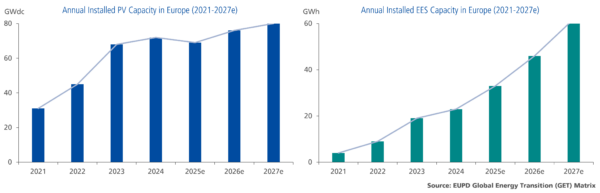
The most significant and exciting trend reshaping the residential solar market is the shift toward PV-plus-storage (solar paired with batteries).
According to industry analysis, the ability to integrate storage is no longer optional; it is becoming essential for project viability across residential, commercial, and utility sectors.
Why Batteries Are Now the Baseline
In the U.S. especially, grid congestion, volatile energy prices, and the increasing frequency of severe weather events are driving this change. For homeowners, energy storage solves critical problems that solar panels alone cannot address:
1. Maximizing Self-Consumption and ROI
Net metering policies are evolving. Many utilities are moving toward structures that reduce the credit you receive for sending excess power back to the grid.
With a home battery, you can store the energy your panels generate during the sunny afternoon hours and use it yourself during the expensive evening peak hours. This practice, known as peak shaving, ensures you are utilizing 100% of your clean energy, maximizing your savings, and reducing your reliance on fluctuating utility rates.
2. Resilience and Backup Power
In 2023, the U.S. experienced 28 separate weather/climate disaster events with losses exceeding $1 billion each. Power outages are becoming longer and more frequent.
A solar system without a battery typically shuts down when the grid goes down for safety reasons. A PV-plus-storage system allows your home to automatically disconnect from the grid and run essential appliances (lights, refrigerator, medical devices, HVAC) using the stored solar energy.
3. Taking Advantage of Incentives
Crucially, the federal Inflation Reduction Act (IRA) offers a substantial 30% Investment Tax Credit (ITC) for solar installations. This credit also applies to standalone battery storage systems, making the financial case for pairing PV and storage stronger than ever before.
ProsperShield’s Integrated Approach
We specialize in designing fully integrated PV and battery solutions. We don't just bolt on a battery; we engineer a cohesive energy management system tailored to your specific consumption habits and resilience needs.
If you want to secure your energy future and maximize the federal tax credits available, now is the time to act.
Schedule a free consultation with our experts today to see how PV-plus-storage can work for your home. You can also Calculate your savings right now to get an instant estimate.
Section 3: The New Rule of Competition—Quality Execution and Policy Alignment
As the solar market matures and panel prices stabilize, competition is shifting away from who can offer the cheapest panel and toward who can offer the highest quality system integration and execution.
For homeowners, this means scrutinizing your installer's track record, not just the quoted price.
Look Beyond the Panel Price Tag
In a market where structural oversupply exists, virtually every installer has access to low-cost panels. The differentiator is the quality of the installation, which directly impacts the system’s longevity, safety, and performance.
Ask potential installers these critical questions:
- What is your experience with local permitting and policy? (Delays in permitting are a major source of homeowner frustration and cost.)
- How do you handle roof integrity? (Solar installation involves penetrating the roof; ensuring proper sealing and warranty protection is paramount.)
- Are your technicians certified and employed, or are they subcontractors? (In-house teams generally provide more consistent quality control.)
- Do you offer comprehensive energy solutions beyond just solar? (An installer who understands the entire home envelope—HVAC, insulation, roofing—can deliver a much more efficient total solution.)
ProsperShield has completed over 24,000 installations across 42 states, meaning we understand the regional policy nuances, permitting requirements, and specific weather challenges that define successful, long-lasting solar projects. Our focus is on long-term execution quality, not just moving volume.
The Importance of System Integration
Modern solar systems are complex ecosystems. They involve PV optimization, battery management, smart inverters, and often EV charging integration. When installers focus purely on volume, these integrations often suffer, leading to technical glitches, reduced efficiency, and warranty headaches.
Choosing a company that prioritizes sophisticated design and seamless integration ensures your system operates at peak performance for 25+ years.
Section 4: Actionable Advice—Maximizing Your Home Energy Efficiency and ROI
To truly capitalize on the current market dynamics—lower module prices and high-value storage solutions—homeowners must take a holistic view of their energy use. Solar is most effective when paired with a highly efficient home.
Step 1: Audit Your Energy Consumption
Before sizing a solar system, understand where your energy goes. This is where ProsperShield’s expertise in comprehensive home improvement comes into play. If your home is leaking energy, you’ll need a much larger (and more expensive) solar system than necessary.
Key areas to evaluate:
- Insulation: Poor attic or wall insulation is the number one energy waster.
- HVAC Systems: Older, inefficient heating and cooling units can consume half your total electricity.
- Roofing: A new, energy-efficient roof can significantly reduce heat transfer and improve the lifespan of your solar panels.
By addressing these foundational issues first, you can potentially reduce your required solar array size, saving you money on hardware and installation costs.
Step 2: Lock in Financing and Incentives Now
While panel prices are trending down, interest rates and incentive structures are subject to change. Securing financing and locking in the current 30% federal ITC is essential.
- Federal Tax Credit: The 30% ITC applies directly to the cost of solar and battery installation. This is a dollar-for-dollar reduction in your federal tax liability.
- State and Local Incentives: Many states and local utilities offer rebates, SRECs (Solar Renewable Energy Credits), or favorable loan programs that stack on top of the federal credit.
We provide clear guidance on maximizing every available incentive to ensure your system pays for itself as quickly as possible. To learn more about our integrated solutions and financing options, Explore our solar services and see how we can bundle your solar, roofing, and HVAC needs.
Step 3: Prioritize System Monitoring and Warranties
The shift to quality execution means demanding robust warranties and sophisticated monitoring tools. A high-quality system should come with:
- 25-Year Panel Performance Warranty: Guaranteeing power output over time.
- 10-25 Year Equipment Warranty: Covering the inverter and battery components.
- Installation/Workmanship Warranty: Protecting against roof leaks or installation failures (this is where quality installers truly differentiate themselves).
Modern systems also include monitoring apps that let you track production, consumption, and battery status in real-time, putting you in complete control of your energy future.
Section 5: Partnering with ProsperShield for Your Solar 2.0 Solution
The solar market is no longer a wild west of rapid, uniform expansion. It is a sophisticated, mature market demanding excellence in integration, execution, and customer service. This is exactly where ProsperShield excels.
We understand that your home is your most important asset. We don't just install panels; we deliver a complete, customized energy ecosystem that maximizes the benefits of lower hardware costs and essential energy storage.
Our commitment to quality execution includes:
- Integrated Solutions: We are experts in PV, battery storage, high-efficiency HVAC, insulation, and roofing, ensuring every aspect of your home improvement supports energy efficiency.
- Broad Coverage, Local Expertise: Operating in 42 states, we have the scale and experience (24,000+ installations) to navigate complex regulations while providing the personalized service of a local expert.
- Focus on ROI: Our designs prioritize maximizing self-consumption and resilience, ensuring you benefit immediately from the falling solar panel prices and the stability of reliable battery backup.
Don't let market stabilization confuse you—it’s the best time in history to go solar. The convergence of lower hardware costs and powerful incentives creates an unprecedented opportunity for savings and energy independence.
Ready to capitalize on the Solar 2.0 era? Let’s design a system that secures your home's energy future.
Call us today at 877-317-9079 or visit us online at prospershield.io to start your consultation.
Frequently Asked Questions (FAQs) About the Changing Solar Market
Q: If panel prices are falling, should I wait to install solar?
A: Waiting is generally not recommended. While module costs are decreasing, the overall cost of a solar system is heavily influenced by labor, permitting, and financing—factors that are not decreasing. Crucially, the 30% federal tax credit (ITC) is currently locked in, but future policy changes are always possible. Furthermore, every month you wait is a month you are paying high utility rates and missing out on decades of clean energy production.
Q: How much does adding battery storage increase the cost of my system?
A: Battery storage does increase the initial upfront cost, but it dramatically increases the long-term value and resilience of the system. For many homeowners, the ability to achieve true energy independence, protect against blackouts, and maximize self-consumption during peak utility hours justifies the investment. Plus, the battery is eligible for the same 30% federal tax credit as the panels, significantly offsetting the cost.
Q: Does ProsperShield only install solar panels?
A: No. ProsperShield is a full-service home improvement company focused on energy efficiency. We offer solar installation, battery storage, high-efficiency HVAC systems, insulation upgrades, and roofing services. We believe in taking a whole-home approach to energy savings, ensuring your solar investment is built upon a highly efficient foundation.
Topics
Ready to Go Solar?
Get a free consultation and see how much you could save with ProsperShield solar.