
The Future of Home Solar: Why Quality and Battery Storage Matter Now
Global solar is changing. Oversupply is lowering costs, but installation quality and battery storage are the new keys to maximizing your savings and achieving true energy independence in 2026.
ProsperShield Team
Solar Energy Experts
Your Energy Forecast: Why Changes in the Global Home Solar Market are Great News for Homeowners
If you’ve been watching the news, you might have heard some complex terms swirling around the global energy sector: market adjustment, structural oversupply, and stabilization. While these phrases sound highly technical, the underlying shift in the home solar market trends 2026 and beyond is actually fantastic news for homeowners across the 42 states ProsperShield serves.
We are moving into an era where solar power is more affordable, more reliable, and far more sophisticated than ever before. The focus is no longer just on how many panels can be installed globally, but how well those systems are integrated into your home and the local grid. In short, quality, execution, and battery storage are now the definitive factors for success.
At ProsperShield, we believe this pivot is crucial. It separates the fly-by-night operations focused only on volume from expert providers dedicated to maximizing your long-term savings and energy independence. Let’s dive into what these major industry shifts mean for your home improvement plans and how you can capitalize on the evolving solar landscape.
1. The Price Drop You’ve Been Waiting For: Understanding Structural Oversupply
One of the most significant dynamics currently shaping the solar industry is structural oversupply. Simply put, global manufacturing capacity—primarily driven by massive build-outs in regions like China and India—has begun to exceed the immediate demand for solar panels (PV modules).
While industry pundits see this as a market “flattening,” we see it as a powerful opportunity for homeowners.
What Oversupply Means for Your Wallet
When manufacturing capacity outpaces deployment, prices for the core components—the solar panels themselves—tend to drop. For you, the homeowner, this translates directly into a lower upfront investment for your system. The cost of solar installation is becoming increasingly competitive, making the return on investment (ROI) timeline shorter and the financial benefits clearer.
Key Takeaway: If you were waiting for the right time to go solar based on price, that time is now. We are seeing sustained downward pressure on component costs, which makes achieving energy independence more attainable than ever before.
The Hidden Danger of Low Prices
However, a lower price tag doesn't automatically guarantee a successful installation. As module costs drop, the competition shifts away from sheer volume and toward execution quality. This is the most vital change for homeowners to understand.
In a market defined by cheap components, the expertise of the installer (the Engineering, Procurement, and Construction, or EPC, partner) becomes the single most critical factor. A high-quality, reliable system requires:
- Expert Design: Tailoring the system to your specific roof, energy usage, and local utility regulations.
- Seamless Integration: Ensuring the panels, inverter, and increasingly, the battery storage unit, communicate flawlessly.
- Long-Term Support: Having a partner who handles permitting, warranties, and maintenance for the 25+ year lifespan of the system.
Choosing the cheapest bid often means sacrificing execution quality, leading to costly issues down the road. At ProsperShield, we leverage our experience from 24,000+ installations across 42 states to ensure that while component costs are lower, the quality of our service remains uncompromising.
2. The PV-Plus-Storage Revolution: Why Batteries Are Non-Negotiable
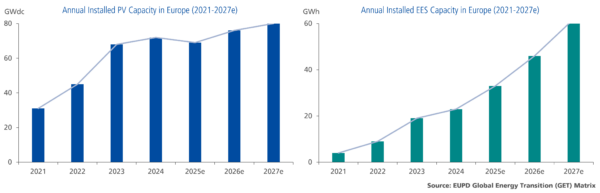
The most profound shift identified by industry experts is the move toward PV-plus-storage as the new standard for project viability. Across the U.S., energy storage is rapidly transitioning from a luxury add-on to an essential component of any modern solar installation.
Why the sudden urgency? It boils down to grid stability, maximizing savings, and achieving true energy independence.
Grid Congestion and Curtailment Risk
As more homes and utilities adopt solar, local grids can become overwhelmed during peak generation hours (midday). This phenomenon leads to grid congestion and curtailment risk—the possibility that your utility forces your system to temporarily stop producing or exporting electricity.
If your system is curtailed, you lose out on savings and potential credits. Battery storage solves this problem immediately. Instead of sending excess power back to a congested grid, your battery stores it locally. This ensures every kilowatt-hour (kWh) your panels generate is used, either immediately by your home or saved for later.
Maximizing ROI with Time-of-Use (TOU) Rates
Many utilities are moving toward Time-of-Use (TOU) rate structures. Under TOU, electricity prices fluctuate drastically throughout the day, often becoming extremely expensive during peak evening hours (e.g., 4 PM to 9 PM).
This is where battery storage shines. A smart PV-plus-storage system allows you to:
- Charge the battery during the day when solar power is abundant and electricity is cheap (or free, if self-generated).
- Discharge the battery during the expensive peak evening hours, effectively running your home on stored energy instead of pulling costly power from the utility.
This strategy is often called load shifting and dramatically increases the financial value of your solar investment, ensuring your solar panel installation costs pay off faster.
Resilience: The True Value of Energy Storage
Beyond financial savings, the most compelling reason homeowners are prioritizing battery storage is resilience. With increasing extreme weather events and aging infrastructure leading to more frequent and prolonged power outages, the ability to keep your lights, refrigerator, and essential medical equipment running is invaluable.
Solar panels alone often shut down during a grid outage for safety reasons (anti-islanding). A battery system, like the ones ProsperShield integrates, creates a microgrid for your home, allowing your panels to continue generating power and charging the battery during a blackout.
If you are serious about achieving energy independence and protecting your family from grid volatility, battery integration is paramount. Schedule a free consultation with a ProsperShield expert today to design a PV-plus-storage system tailored for your needs and local utility structure.
3. The Comprehensive Home Approach: Beyond Just Panels
The global shift toward execution quality reinforces ProsperShield’s long-standing philosophy: solar is just one piece of the energy efficiency puzzle. True energy savings and a maximized ROI require a holistic approach to your home’s performance.
In a market where system integration is key, we look beyond the roof to ensure your entire home is optimized before the panels even go up.
Step 1: Optimize Energy Usage First
Before investing in a large solar array, the smartest move is to reduce the energy you need to consume. This often involves addressing the largest energy drains in your home:
- HVAC Systems: Older HVAC units are notoriously inefficient. Upgrading to a high-efficiency system can drastically reduce your heating and cooling demands.
- Insulation: Poor insulation is like leaving a window open year-round. Improving attic and wall insulation dramatically stabilizes indoor temperatures, lowering the workload on your HVAC.
By implementing energy efficiency measures first, you can often install a smaller, less expensive solar system while still achieving 100% energy offset. ProsperShield is uniquely positioned to handle this, offering comprehensive services including HVAC, insulation, and roofing alongside our solar installations.
Step 2: The Role of Roofing in Solar Longevity
As the industry focuses on long-term execution, the condition of your roof is critical. Solar systems are designed to last 25 years or more. If your roof is nearing the end of its life, installing solar panels on it is a costly mistake, as the entire system will need to be removed and reinstalled prematurely.
ProsperShield incorporates roofing assessments and replacement into the installation process. We ensure your foundation is solid before we install your energy generator, providing a single point of contact and warranty for both the roof and the solar system. This seamless integration is what defines high-quality installation in the evolving market.
4. Actionable Steps: Choosing the Right Partner in a Changing Market
In the current market, where component costs are falling but execution quality is paramount, selecting the right installer is the single most important decision you will make. Here is your checklist for navigating the home solar market trends 2026:
Checklist for Homeowners:
1. Prioritize System Integration Expertise
Ask potential installers about their experience with complex system integration, particularly PV-plus-storage. Can they handle the electrical requirements, permitting, and smart controls necessary for load shifting and battery management?
- Look for: Companies with a proven track record (like ProsperShield’s 24,000+ installations) that demonstrate expertise across multiple home systems (solar, HVAC, roofing).
2. Demand a Future-Proof System
Even if you aren't ready for a battery today, ensure your system is storage-ready. The inverter should be compatible with battery systems, and the wiring should be designed for easy future integration. Given the industry's direction, a non-storage-ready system is already outdated.
3. Understand Financing and Incentives
While global prices are dropping, U.S. incentives remain a powerful tool for lowering your net cost. Ensure your installer is expert in navigating local and federal incentives, such as the Investment Tax Credit (ITC). The rules around incentive eligibility are constantly changing, and alignment with policy is now a key factor in successful deployment.
4. Ask About Non-Solar Services
If an installer offers a comprehensive suite of services (HVAC, insulation, roofing), it indicates a focus on overall home energy performance, not just selling panels. This holistic view ensures you maximize your energy efficiency before sizing your solar system.
Calculate Your Savings and Next Steps
Ready to see how the current market conditions translate into savings for your home? The combination of lower component costs and generous incentives makes the ROI stronger than ever.
Calculate your savings based on your current energy usage, or if you prefer to speak directly with an expert about system design and financing options, Call us at 877-317-9079.
Conclusion: The Era of Smart Solar Investment
The global solar industry is entering a more mature, stable phase defined by structural oversupply and a critical shift toward execution quality and seamless system integration. For homeowners, this means two things:
- Affordability: Solar panels are cheaper, making the initial investment more palatable.
- Necessity of Quality: The expertise of the installer matters more than ever to ensure a long-lasting, high-performing system that truly maximizes your savings.
The future of home solar is PV-plus-storage. It’s a future defined by resilience, optimized savings through load shifting, and genuine energy independence. Don't settle for a volume-focused installation; demand a comprehensive, high-quality solution.
ProsperShield is committed to providing expert execution across solar installation, battery storage, HVAC, and roofing in all 42 states we serve. Learn more about how we integrate the latest technology with unmatched installation standards. Explore our solar services and take control of your energy future today.
Topics
Ready to Go Solar?
Get a free consultation and see how much you could save with ProsperShield solar.