
Why Falling Solar Panel Prices Make Home Energy Storage Essential
Global trends are driving down solar panel costs. Learn how to maximize your savings and achieve total energy independence by pairing PV with essential home battery storage.
Craig Stratton
Founder & CEO, ProsperShield
The New Energy Era: Why Now Is the Perfect Time to Invest in Solar and Storage
If you’ve been watching the solar market, waiting for the perfect moment to take the plunge, that moment is officially here.
We’re witnessing a massive shift in the global solar industry—a shift that is overwhelmingly beneficial for American homeowners like you. Traditionally, the cost of solar installation was primarily driven by the hardware itself. But thanks to global manufacturing dynamics, solar panel prices are dropping significantly.
While lower component costs are fantastic news for your wallet, this market adjustment is redefining what makes a successful, long-lasting solar investment. The focus is moving away from sheer volume of installations and toward superior quality, flawless execution, and—most importantly—system integration, particularly with battery storage.
At ProsperShield, we recognize that the future of home energy is not just about generating power; it’s about controlling it. This comprehensive guide will break down the current market trends, explain why PV-plus-storage is now the gold standard, and show you how to leverage these changes to maximize your energy savings and independence.
Section 1: The Global Shift – Why Solar Hardware Is Getting Cheaper
The solar industry operates on a massive global scale, and recent dynamics—particularly strong manufacturing output from regions like Asia—have created a structural surplus of solar modules. While this might sound like complex industry jargon, the takeaway for homeowners is simple and exciting: the cost of the panels themselves is decreasing.
For years, the industry was defined by rapid, uniform expansion. Now, growth is stabilizing in mature markets like the U.S. and Europe. As global supply outpaces immediate demand, competition shifts, and prices fall. This means the barrier to entry for owning a solar system is lower than ever before.
What Lower Component Costs Mean for Your Budget
When hardware costs drop, the overall cost of a residential solar installation becomes more accessible. This improves your system’s Return on Investment (ROI) and shortens the payback period.
However, it’s crucial to understand that solar installation involves much more than just the panels. The true cost and value are now increasingly tied to the soft costs and the quality of installation:
- Execution and Permitting: Navigating local regulations, securing permits, and ensuring a flawless, timely installation requires expertise.
- System Design: Optimizing panel placement, integrating electrical components, and ensuring maximum efficiency for your specific roof and climate.
- Storage Integration: Adding battery backup requires specialized knowledge to safely and effectively couple the battery with the PV array and your home’s electrical system.
The takeaway: Don't chase the absolute lowest price on a panel. Focus instead on finding an installer that offers high-quality, efficient hardware paired with impeccable execution.
Section 2: Quality Over Volume – Choosing the Right Partner
As the industry matures, the competitive landscape is shifting. It’s no longer about who can install the most systems the fastest; it’s about who can deliver the most reliable, high-performing, and policy-aligned system that lasts for decades.
For homeowners, this translates to demanding higher standards from your installer.
The Importance of Execution and Policy Alignment
In the U.S., installation activity is increasingly shaped by local incentive eligibility, trade enforcement rules, and complex permitting timelines. An installer operating across multiple states (like ProsperShield, covering 42 US states) must be agile, knowledgeable about regional policy changes, and capable of handling complex bureaucratic processes quickly.
A shoddy installation or a slow permitting process can negate any savings you realize from cheaper panels.
When vetting solar companies, ask about their track record, their engineering process, and their commitment to long-term service. At ProsperShield, we pride ourselves on our execution quality, having completed 24,000+ installations across the country. Our deep understanding of regional policies ensures your project moves smoothly from consultation to activation.
Ready to partner with an expert who prioritizes quality and execution?
Explore our solar services and see why thousands of homeowners trust our execution and system integration expertise.
Section 3: The PV-Plus-Storage Revolution – Why Batteries Are Now Essential
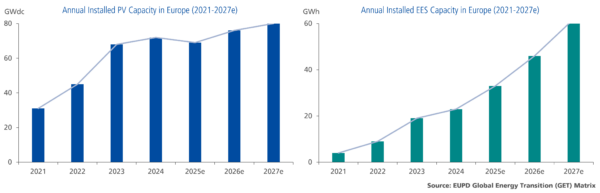
The single biggest shift detailed in market analysis is the rise of energy storage. Across residential, commercial, and utility sectors, the ability to integrate storage is no longer optional—it’s becoming a requirement for project viability.
Why? Because the grid is changing, and so are the economics of solar ownership.
1. Combating Grid Congestion and Curtailment Risk
As more solar comes online nationally, particularly in densely populated areas, the electrical grid struggles to handle the influx of power during peak generation times (midday). This leads to:
- Curtailment: Utilities sometimes limit the amount of solar power your system can send back to the grid, meaning you lose potential earnings.
- Grid Congestion: High demand and high generation simultaneously stress local infrastructure, leading to instability and potential outages.
The Battery Solution: A home battery system captures that excess solar energy that would otherwise be curtailed or sent back to a congested grid. Instead, it stores the power for later use, maximizing your self-consumption and ROI.
2. Mitigating Price Volatility and Peak Charges
Many utility providers are shifting to Time-of-Use (TOU) billing, where electricity prices are significantly higher during peak evening hours (e.g., 4 PM to 9 PM).
The Battery Solution: By storing cheap solar energy generated during the day, your battery allows you to power your home during those expensive evening peak hours. This practice, known as peak shaving, drastically reduces your reliance on expensive grid power, providing predictable, lower energy costs.
3. True Energy Independence and Backup Power
In an era of increasing weather volatility and aging infrastructure, homeowners are prioritizing resilience. A solar array without a battery shuts down when the grid goes down (for safety reasons).
The Battery Solution: A home battery automatically kicks in during an outage, providing seamless backup power to critical appliances (lights, refrigerators, medical devices, HVAC). This shift from simply reducing your bill to ensuring continuous power security is why homeowners increasingly view storage as a necessity, not a luxury.
| Feature | Solar Only (Without Battery) | PV-Plus-Storage (With Battery) |
|---|---|---|
| Grid Outage Performance | Shuts down immediately | Provides seamless backup power |
| Peak Hour Savings | Relies on Net Metering rates | Uses stored solar energy for peak shaving |
| Self-Consumption Rate | Lower (sells excess to grid) | Higher (uses stored power first) |
| Investment Security | Vulnerable to Net Metering changes | Protected against policy changes |
Section 4: Maximizing Your ROI with Integrated Home Solutions
The declining cost of solar panels coupled with the essential nature of battery storage means that the Federal Solar Investment Tax Credit (ITC) is more powerful than ever. When you install both solar panels and qualified battery storage, the entire system is eligible for the substantial federal credit, dramatically lowering your net installation cost.
This is where system integration and holistic home improvements come into play. A truly efficient home doesn't just generate power; it conserves it.
Beyond the Roof: A Total Home Energy Strategy
ProsperShield doesn't just install solar; we specialize in creating truly efficient homes. Before maximizing solar production, we help homeowners minimize consumption. If your home is leaking energy, you’ll need a larger, more expensive solar system to compensate.
Consider integrating these services alongside your PV and storage installation to achieve maximum savings:
1. Advanced HVAC Systems
Heating and cooling typically account for the largest portion of a home’s energy bill. Upgrading to a modern, high-efficiency HVAC system, such as a heat pump, can dramatically reduce your energy load, meaning your solar system can be smaller and more affordable while still covering 100% of your reduced energy needs.
2. Insulation and Air Sealing
Proper attic insulation and air sealing are the foundation of energy efficiency. By preventing conditioned air from escaping, you reduce the strain on your HVAC system and, consequently, the demand on your solar panels. This is often the quickest way to see immediate savings.
3. Modern Roofing
Solar panels are a 25+ year investment. Installing them on an aging roof is risky. ProsperShield offers comprehensive roofing services, ensuring your panels are installed on a solid, long-lasting foundation, preventing costly re-installation down the road.
By viewing solar, storage, and efficiency upgrades as one integrated project, you optimize your use of incentives, reduce overall energy waste, and secure the lowest possible monthly energy expenses.
Ready for a holistic assessment of your home's energy needs? We cover everything from solar and batteries to roofing and HVAC across 42 US states.
Schedule a free consultation with a ProsperShield expert to design your total energy shield.
Section 5: Actionable Tips for Homeowners Navigating the New Solar Market
The market trends are clear: cheaper hardware combined with the essential need for storage demands a smarter approach to solar purchasing. Here are the steps ProsperShield recommends for homeowners in 2024 and 2025:
1. Prioritize System Integration Expertise
Since storage is the new standard, ensure your installer is highly experienced in PV-plus-storage solutions. Ask detailed questions about the battery technology they use, how it handles peak shaving, and the warranty coverage for the entire integrated system.
2. Understand Your Energy Usage Profile
Don’t just look at your average monthly bill. Understand when you use the most power. If you work from home or run A/C heavily in the evenings, a battery becomes exponentially more valuable for managing those peak TOU rates.
3. Look Beyond the Panels
As panel costs decrease, the quality of wiring, inverters, racking, and installation labor becomes the defining factor in system longevity. Avoid companies that cut corners on these essential components to offer an artificially low price. Remember, a solar system is a long-term asset; skimping on quality leads to higher maintenance costs later.
4. Leverage Financing Options
With favorable interest rates and the substantial Federal ITC, many homeowners find that their monthly solar financing payment (before energy savings) is comparable to, or even less than, their current utility bill. Explore ProsperShield’s financing options to make the switch immediately profitable.
5. Check Local Incentives and Net Metering Status
Policy changes are frequent. While national trends point toward less generous traditional Net Metering programs, many states and utilities offer specific incentives for integrating battery storage (e.g., specific battery rebates or performance incentives).
An expert installer, like ProsperShield, stays ahead of these complex regional rules, ensuring you capture every available dollar in incentives.
Conclusion: Secure Your Energy Future Today
The solar industry is entering a period of refinement where quality, execution, and integrated storage solutions determine success. This market shift presents a unique opportunity for homeowners: access to more affordable core technology (panels) combined with the ability to secure true energy independence through battery storage.
Don't let the complexity of policy changes or grid instability deter you. Instead, view these factors as compelling reasons to upgrade to a resilient, integrated PV-plus-storage system built by experts.
ProsperShield is committed to helping homeowners across 42 US states achieve maximum savings and security through superior solar installation, battery storage, and holistic home efficiency upgrades. With 24,000+ success stories, we have the experience to design a custom solution that truly shields your prosperity.
Ready to calculate your potential savings and see how affordable energy independence can be? Try our Savings Calculator or Call us at 877-317-9079 today to start your free consultation.
Topics
Ready to Go Solar?
Get a free consultation and see how much you could save with ProsperShield solar.